
Introduction
Electricity is fundamental to most modern industrial processes. Whether it is manufacturing plants, generation stations, infrastructure, commercial buildings or renewable energy sources they will all require electricity in order to function. This electricity can be supplied to the machinery and equipment via industrial power cables.
To help engineers, contractors, purchasing and business owners understand what industrial power cables are used for, it is important to know what sort of cables would be best for the industry you are working with. Different industries will all have different loads and requirements. Choosing the right cable type will help to ensure the right choice.
There are various types of industrial power cables that you can choose from. These will vary depending on the conductor, voltage, insulation type and protection.
This article will discuss the main uses of industrial power cables, common types and what to look out for.
1. What are Industrial Power Cables?
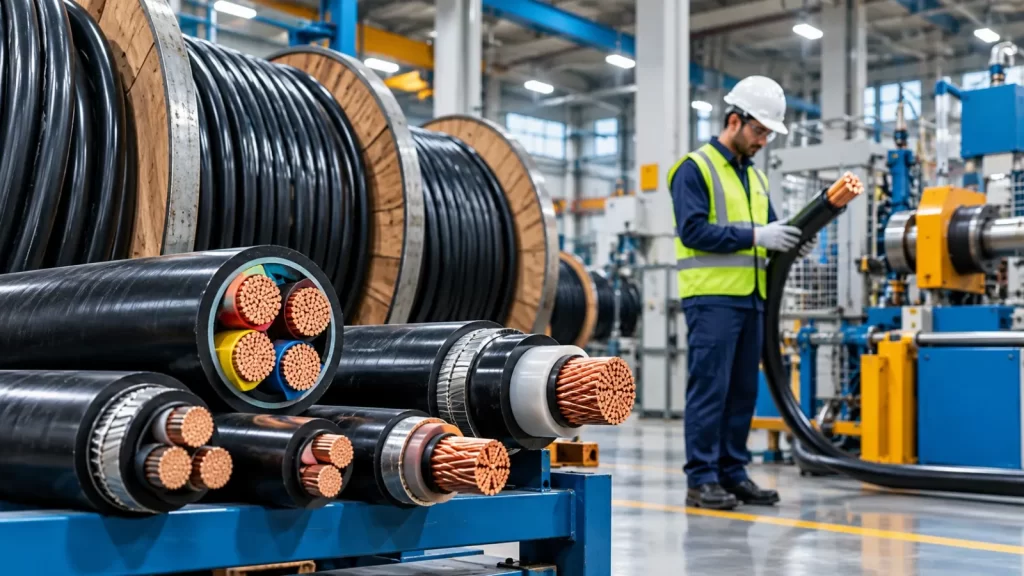
Industrial power cables are cables that can supply and distribute electrical energy to machinery, equipment, buildings and distribution.
Industrial power cables can be used in a variety of applications including machinery in factories, electrical panels, sub stations and renewable energy. They can vary in construction depending on the voltage, current and installation requirements. Some cables will also have more protection than others.
These can include:
Conductor – Usually copper or aluminium, carries current.
Insulation – Keeps the conductor isolated from other conductors.
Outer Sheath – Extra protection against specific environmental and mechanical.
Armouring/ Screening – Some designs will include armouring or screening to protect.
Not all cables will have all 4 elements. It will depend on the application and product.
2. Significant Industrial Cable Applications
2.1 Factories & Manufacturing Units
Factories will use electrical cables to power the production line, conveyors, motors, pumps, compressors and automation.
These cables will be used to connect to the electrical distribution within the factory and can be used to power machinery, distribution boards, motor control centres and other industrial equipment.
When selecting cables for factories the following need to be considered:
Current, Voltage, Temperature, Installation and any exposure to chemical substances (oils/chemicals).
For example, cables may be installed in a safe electrical enclosure so will have different requirements than if they are laid near moving machinery.
By using cables suitable for the environment being used it ensures a reliable power distribution.
2.2 Power Stations
Electrical cables are used in power stations to provide power to generation equipment, auxiliary devices, transformers, switchgear, pumps and other equipment.
The type of power station will determine what type of cables are needed. For example, thermal, hydro or renewable energy.
Electrical cables will be used to provide power to the station however there will also be control and instrumentation cables.
Voltage, Temperature, Exposure and the application requirements will need to be considered when selecting the cables.
Testing may be required to be documented and cables will need to meet the correct standards. Engineers should confirm that the cables are suitable for the circuits they are being used in.
2.3 Substations & Distribution
A substation helps to distribute electrical power between the different parts of the network. Equipment will include transformers, switchgear, circuit breakers and distribution.
Electrical cables may be used to connect equipment within the station or be used as part of an underground distribution and industrial distribution.
LT and HT cables will be used depending on the voltage of the application.
When installing underground cables engineers will need to consider the soil conditions, moisture, mechanical protection, cable laying and installation requirements.
Careful cable selection will ensure that the cables meet the requirements of the distribution requirements.
2.4 Large Commercial & Industrial Buildings
Large buildings will require electrical power to provide lighting, lifts, heating, ventilation, air conditioning, pumping, security and other equipment.
Electrical cables will be part of the distribution to provide power to these systems from the incoming distribution boards.
Cable selection will depend on the electrical load, circuit design, cable laying, installation conditions and safety requirements.
Some projects will require cables to be specified with certain fire retardant, low smoke or fire resistant properties for certain areas. These are all different and shouldn’t be confused with each other.
By working with the electrical design and technical requirements of the project it ensures that the correct cables will be chosen for the buildings systems.
2.5 Renewable Energy
Renewable energy such as Solar and Wind requires the correct cabling to transfer and distribute power.
Solar uses photovoltaic cables for the correct DC connections and suitable power cables. Wind energy will require the right cabling for the Turbine equipment, power conversion and
distribution.The environment is important.
Solar cables may need to have UV, Heat and the correct DC voltage resistance. Wind energy may involve vibrations, movement and stress meaning specific cables are required.
Having the correct cables with the right electrical and environmental ratings can help ensure the system will work reliably.
2.6 Oil, Gas & Chemical Industries
Oil refineries, Gas processing, Chemicals and other process industries all use electricity to run various pieces of equipment such as pumps, compressors, motors, production equipment and ancillary equipment.
Cables may be exposed to high temperatures, dampness, oils, chemicals and stresses.
Some facilities have hazardous areas which require specific equipment to be used. Cables will need to be selected according to the engineering design.
Engineers should consider the type of insulation and sheathing, temperature rating, mechanical protection and environment.
Not all industrial power cables will be suitable for use in chemical plants or hazardous areas. The cable specification should be checked.
2.7 Mining & Heavy Industry
Mining and heavy industry use electricity to run conveyors, crushers, pumps, drills, processing equipment and material handling equipment.
Cables may be prone to rubbing, vibrations, shocks, dust, dampness and movement.
A cable with a fixed installation design may not be suitable for moving/flexible machines. Depending on the machine different cable designs may be needed.
Selecting the correct cable by considering the voltage rating, conductor size, insulation, mechanical protection and industry requirements.
Correct cable selection & installation will reduce risks of mechanical damage and ensure reliable equipment.
2.8 Infrastructure & Transport
Airports, Railways, Tunnels, Water Treatment and Large Construction all require reliable electrical distribution.
Industrial power cables may be used to power pumps, ventilation, machines, distribution boards and other vital equipment.
These projects may have long cable runs, underground, confined spaces and challenging environments.
Cable selection should consider the current requirement, voltage drop, installation method, exposure and technical requirements.
By working with the designers, contractors and suppliers early you can ensure the correct cables are chosen to suit your project.
3. Common types of power cables.
Low Voltage (LT) Power Cables
Used in Low Voltage power distribution circuits, up to the rated level. May include supplying to machinery, electrical panels and systems in industrial buildings.
High Voltage (HT) Power Cables
Used in high voltage applications up to the cables rated voltages and to relevant standards. These may be needed for substation, industrial distribution systems and utility projects.
Armoured power cables
Have a protective layer to provide the required mechanical protection. These may be suitable for some applications underground or in industrial environments.
Un-armoured power cables
Where the design of the installation provides sufficient protection.
Copper conductor cables
Contain a copper conductor. Copper provides excellent conductivity and is commonly used in many power distribution applications.
Aluminium conductor cables
Contain an aluminium conductor, which is lighter than copper for the same conductor volume.
However, care must be taken with the sizing and terminating.Depending on the application, the best cable to use will vary.
4. Choosing the right industrial power cable.
Voltage rating
The cable must be rated to work at the correct voltage. This can be confirmed by engineers to ensure that the voltage rating matches the design requirements and standards.
Current carrying capacity
Ensure that the conductor can safely carry the expected current load in the conditions that the cable will be installed in. Cable sizing will depend on ambient temperatures, cable grouping, installation type and design of circuit.
Conductor material
Copper and aluminium conductors have different properties, depending on what is required from the system you will need to choose the right conductor material. This will depend on the conductors size, system requirements, connector type and other project considerations.
Insulation and Sheath
Ensure the insulation and sheath are suitable for the temperature, environmental conditions and installation conditions they will be exposed to.
Armouring
If the installation requires armouring then this should be considered.
Standards
Ensure that the product conforms to the correct standards. Ensure that there is adequate technical information available and that the product has been tested to the correct reports. The product provided should match the approved specification.
Supplier
Ensure that the supplier has the right range of products, technical information, quality processes, manufacturing lead times and can meet your requirements.
For critical electrical installations the cable type and size should be reviewed by a qualified electrical engineer.
5. Importance of Cable Quality and Testing
Industrial electrical systems require cables that are of good quality and will meet the application requirements and product specifications.
Depending on the design and standard, various tests can be carried out such as measuring the resistance of the conductors, insulation resistance, voltage withstand, dimension checks etc.
When purchasing cables ensure you have the correct technical data sheets and test reports available.
Always make sure you are receiving the correct product to the approved spec as products can look similar but have different conductor sizes, insulation types, voltage ratings and protection types.
Having quality assurance, proper installation, correct electrical protection and regular maintenance will help ensure your industrial electrical system is reliable.
6. Benefits of Using The Right Industrial Cable Supplier
Having a suitable supplier will make life easier by:
Having someone that can explain product details, provide product documentation, explain what types of cables are available and realistic delivery times.
Consider whether the supplier has:
- The right types of cable available.
- Clear technical details and product documentation.
- Appropriate quality and testing documentation.
- Ability to deliver the right amount of product in a timely manner.
- Technical support.
- Products suitable for the application.
If you have a specific application then it is best to ensure you know the exact cable construction and ratings. Not all suppliers will be able to supply all types of industrial cable.
7. Industrial Power Cable Solutions
Flashtronics Technologies supply a variety of wire and cable solutions.
To help find the right cable for your application, ensure you know what voltage rating, conductor material and size, insulation, environment, amount needed and any relevant standards you need.
This will help ensure that we have the right products to suit your application.
Take a look at our range of wires and cables by visiting Flashtronics Technologies and get in touch with us.
Frequently Asked Questions
What are industrial power cables?
Industrial power cables are used for transporting and distributing electricity to machinery, equipment, buildings and electrical distribution systems within manufacturing, energy, infrastructure and transport environments.
What is the difference between LT & HT power cables?
LT & HT cables are used on different voltages. It will depend on your system voltage, cable rating, installation requirements and standard.
When would I use an armoured cable?
Depending on the design of the cable and installation requirements you may use an armoured cable if you require a certain level of mechanical protection in your installation. This can be in some industrial or underground applications.
Are copper cables better than aluminium cables?
It depends on your application. Copper provides greater electrical conductivity per volume but aluminium is lighter. It will depend on your electrical requirements, conductor size, installation requirements and compatible terminations.
How do I know which power cable to use in my factory?
You need to consider the voltage rating, electrical load, conductor size, insulation, environmental requirements, mechanical protection and standard. It is best to get a qualified electrical engineer to confirm what cable you should use.
Conclusion
Industrial Power Cables are an essential part of electric distribution to help ensure safety within manufacturing sites, power generation sites, substation, renewable energy and more.
Knowing what you need industrial power cables for will allow you to select the right cables for your business. Whether you need Low Tension Cables, High Tension Cables, Armoured Power Cables or Renewable Energy solutions, they should always be based on genuine specifications to suit your needs.
Ensure you choose high quality cables with the correct testing, sizes and installation to make sure you are making the right purchase.
Flashtronics Technologies offer a variety of wiring and cabling solutions. Visit our website to find out how we can help with your requirements.