
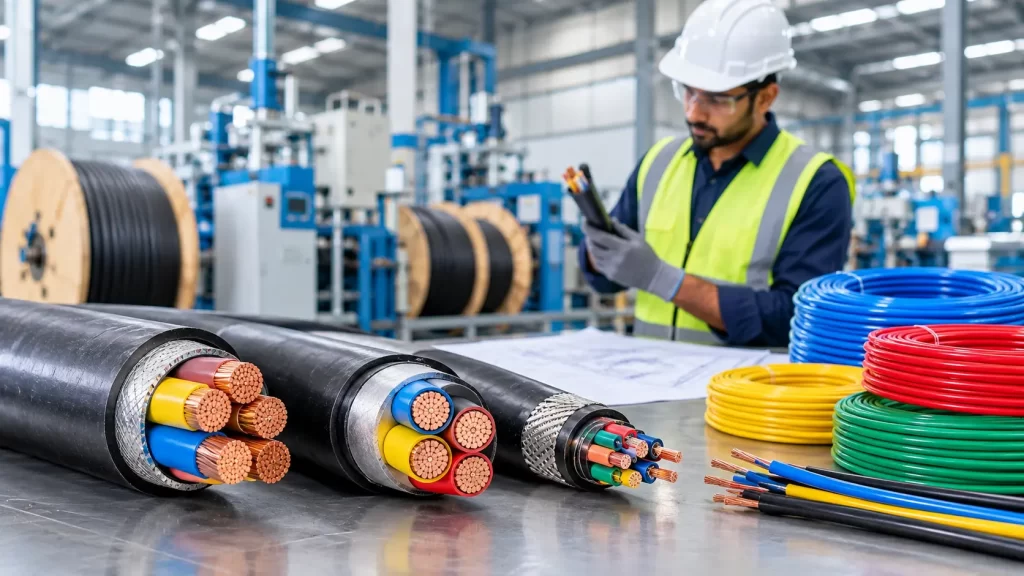
Introduction
Electrical cables are an integral part of any modern industrial or commercial operation. As such, they can be used to link your kit, transfer power, control signals and more.
But often, off the shelf cables will not fit your exact needs. Some businesses will require cables with specific conductor types, insulation, size, voltage rating, shielding and environmental properties.
Custom Cable Manufacturing
Custom cable manufacturing enables the development and manufacture of wires and cables to meet the electrical, mechanical and environmental requirements of your application. This allows you to speak to a manufacturer and discuss the requirements of your project to identify a cable design.
These can be very useful for OEMs, Industrial Automation Companies, Infrastructure Developers, Renewable Energy Businesses and Specialised Equipment Manufacturers.
In this guide, we explain what custom cable manufacturing is, how it works, the many benefits of using it, which industries use customised cables and what to consider when choosing a manufacturing partner.
1. What Is Custom Cable Manufacturing?
Custom cable manufacturing is the design and manufacturing of electrical cables and wires to suit specific application requirements.
Custom cables differ from standard cables, as they are specifically designed to meet specific cable requirements for a certain project, machine or electrical system.
Depending on the capabilities of the manufacturer, custom cables can include:
- Conductors (material type and size)
- Number of cores/conductors
- Cable size and construction
- Insulation and jacket material
- Coloured coding and cable identification
- Shielding
- Armouring and/or protection
- Temperature requirements
- Length and packaging
For example, if you manufacture industrial machinery, you might have a requirement to have a multi-core cable with specific conductor sizes and insulation. If you manufacture solar equipment, you might have a cable requirement that works well in specific outdoor environments.
This allows companies to look at cable designs to meet the application.
It is important to note that there are two types of custom cable manufacturing: bulk and cable assemblies. Bulk cable manufacturing is just the cable, whilst cable assemblies can also include connectors, terminations, wiring harnesses, labelling, protective sleeving and termination. Be sure to check what services your manufacturer can provide.
2. Why You Might Need a Custom Cable Solution
Different businesses have differing requirements for the cables they use. This is where cable solutions can be useful.
There are several reasons why you might want to have a custom cable solution:
Specific Requirements
Some applications will require the cable to have a certain conductor, voltage, amperage and/or conductor counts.
Using a custom cable solution could help with the cable construction.
Specific Installation Requirements
Some cables will need to fit in tight areas, have specific pathways or be used in bespoke equipment.
This could mean that the cable size, flexibility, bend radius and outer sheath could become important.
Environmental Requirements
Industrial equipment can be used in areas which will be hot, damp, exposed to UV, oily, chemical, vibrational and/or stressful.
Depending on the application, it may be required that the cable have certain insulation and sheath materials.
Equipment Specific
Many OEMs will design their equipment and machinery with specific electrical connection requirements.
Using a custom cable solution could help with the conductor layout, length, cores and other specifics.
Project Specific
Infrastructure and Engineering projects often come with technical drawings and specific cable requirements.
A custom cable solution could be considered if the cable does not meet the requirements of the project.
3. Various Elements That Can Be Customised
There are a number of design elements involved with creating custom cables.
3.1 Conductor
This is the element which carries the electrical current.
Common materials used include copper and aluminium.
Copper is very conductive and is often used in electrical cables. It has high conductivity per volume. The downside to using copper is that it’s heavier than aluminium. Aluminium can be used; however, it must be sized correctly with the right termination.
The correct material will depend on the electrical requirements, mechanical properties, installation and project requirements.
3.2 Conductor Size
Conductor sizes will generally be measured by the cross section of the conductor. This is usually measured in mm².
The required size will depend on:
Expected current to be carried.
Voltage drop requirements.
Length of cable.
Installation.
Temperature and cable grouping.
Short circuit requirements.
It’s important to select the right size conductor to ensure the electrical performance and temperature of the cable.
3.3 Number of Cores
Within the cable there can be just one conductor or multiple insulated conductors.
Multi-core cables have multiple conductors.
These can be used within industrial machinery, control panels, connecting equipment and other electrical applications that require multiple circuits/connections.
The number of cores and their specifications should match the electrical design.
3.4 Insulation
This provides insulation between conductors and protects the cable during operation.
Depending on the application, there can be various options available from the manufacturer. For example, some cables will have PVC insulation, whilst others will have XLPE or other suitable polymer.
Each material will have different properties.
The correct option will depend on the voltage rating, temperature, flexibility and applicable standards.
3.5 Outer Sheath
An outer sheath provides extra protection to the cable.
The material and thickness can be selected depending on what the cable is to be installed in.
For example, industrial cables may be required to have a certain level of abrasion, water, temperature and environmental resistance.
3.6 Shielding & Protection
Some cables will have electrical shielding to help reduce electromagnetic interference.
Others may have armouring or extra protection.
This can be an important element to certain control, instrumentation and industrial cables.
However, they are two separate elements and should be selected based on what the cable actually requires.
4. How does custom cable manufacturing work?
The custom cable manufacturing process generally starts with understanding the application of your cable and converting the customer’s request into a technical cable specification.
The process can consist of the following:
Typical manufacturing workflow
- Requirement collection
Understand the application, electrical load, operating conditions, dimensions, and project requirements. - Cable design and specification
Define conductor material, size, core count, insulation, sheath, shielding, and other relevant features. - Material selection
Select suitable conductor and insulation materials based on the approved design. - Conductor processing
Prepare the conductor through relevant processes such as wire drawing and stranding, depending on the design. - Insulation and cable assembly
Apply insulation and assemble conductors into the required cable construction. - Sheathing and finishing
Add the specified protective layers, markings, and product identification. - Inspection and testing
Carry out applicable electrical, dimensional, and physical tests. - Packaging and dispatch
Package the finished products according to the agreed specifications and delivery requirements.
Not every cable follows exactly the same manufacturing sequence. Processes such as armouring, shielding, and multi-core assembly depend on the particular cable design.
5. Industries Using Custom Cables
Cables can have customised requirements within certain industries.
5.1 Industrial Automation
Industrial automation uses sensors, control panels, motors, machines and communications.
Depending on the system, you might need cables that have been designed for certain requirements such as conductors, shielding, flexibility and installation.
By using the correct cable design, this can help connect your industrial equipment.
5.2 Automotive & EV
Automotive electrical systems will have several components connected together, including batteries, sensors, electronics, lighting and more.
Vehicle manufacturers and suppliers may need cables designed to their specific requirements such as electrical, mechanical, thermal and vibrational requirements.
With EV applications there can be higher voltage requirements, so it is important to design cables with the correct materials, insulation and validation.
5.3 Renewable Energy
Solar and other renewable energy applications may need cables designed for their electrical and outdoor environments.
Solar applications will need cables with the correct requirements such as voltage rating, UV, temperature, humidity and conductor sizes.
If there are specific requirements for your project then customised cables can be looked into.
5.4 Infrastructure
Infrastructure projects such as airports, railways, commercial and industrial premises will have electrical systems with specific cable requirements.
Cables may need to be customised to fit specific requirements such as routing, electrical, environmental and project requirements.
5.5 Industrial Machinery & OEM
Original equipment manufacturers will often have machinery designed with specific electrical connection requirements.
A custom cable can be designed to fit the conductor requirements, size, routing and environmental requirements of the machine.
This can help the cable match up with the overall electrical design of the equipment.
6. Benefits of Using Custom Cable
Choosing the correct cable will offer benefits such as:
Improved application compatibility
Designing cables based on electrical and mechanical requirements.
Improved installation
Choosing the right size, core layout and construction.
Improved material selection
Manufacturers can choose the best insulation, sheath and conductor for their application.
Improved purchasing
If you regularly have the same requirements having a set cable specification can simplify the process.
Integration with OEM Products
Custom cables can be designed to integrate with specific products and equipment.
Improved cable specification
Technical drawings and cable specifications mean everyone involved can work to the same product requirements.
This is not always the case however, the design must be technically suitable, able to be manufactured and have been properly validated.
7. What information do you need to provide to your custom cable manufacturer?
By preparing clear technical specifications companies will be able to get an accurate quote.
This will help the manufacturer to understand what you require and decide if they can make the cable you need.
| Requirement | Information to provide |
| Application | Where and how the cable will be used |
| Conductor material | Copper, aluminium, or other specified material |
| Conductor size | Required cross-sectional area |
| Number of cores | Single-core or multi-core configuration |
| Voltage rating | Required operating voltage |
| Insulation | Required insulation material |
| Outer sheath | Material and environmental requirements |
| Operating temperature | Minimum and maximum operating conditions |
| Installation | Fixed, flexible, outdoor, underground, etc. |
| Shielding | Whether electrical screening is required |
| Quantity | Prototype, sample, or bulk production requirement |
| Standards | Required Indian or international product standards |
| Delivery | Required length, packaging, and schedule |
Where available, share technical drawings, product datasheets, reference samples, and installation details.
A detailed technical brief can reduce misunderstandings during the quotation, design, manufacturing, and inspection stage
8. Quality Testing
To ensure that a customised cable meets all of the technical requirements set at the design stage quality testing is carried out.
The type of testing required will depend on the type of product, construction, voltage rating and standards.
Testing/inspections typically include:
Resistance testing – to ensure that the conductor has the correct level of resistance.
Insulation resistance testing – to ensure that the cable has the correct level of electrical resistance.
High voltage testing – to ensure that the insulation can withstand the test voltage.
Dimensions – to ensure the conductor, insulation, sheath and cable have the correct dimensions.
Mechanical testing – to ensure the correct mechanical properties are achieved such as tensile strength and elongation.
Specialist cable assemblies may require further testing such as continuity, connectors, pull strength or functionality.
Testing should include details to identify the product and any requirements for acceptance.
9. Choosing your Custom Cable manufacturer
When choosing your manufacturer you may wish to consider the following questions:
Can they manufacture your desired cable type, conductor type and insulation?
Do they have a team who can look at your drawings and discuss any technical requirements?
What type of conductor, insulation and sheath are they using?
What quality check, testing and paperwork do they offer?
Can they help with your design and desired quantity?
What is their manufacturing lead time, minimum order and repeat order?
Choose a supplier that can clearly communicate technical limitations, feasibility and commercial aspects.
If you have an OEM or industrial project it is a good idea to ask if they can provide a sample or prototype to approve before going into full production.
10. Custom Cable Solutions
This business offers bespoke cable and wire for a range of different industries, including automation, infrastructure, renewable energy, automotive and OEM.
The companies services include: bespoke cable design, multi-core cable solutions, OEM manufacture and project based solutions. They also offer a range of quality assurance testing including high voltage testing, insulation resistance testing, conductivity testing and dimension checks.
These services will be beneficial to those looking for bespoke cable products.
If you require cables for industrial equipment, electrical panels, infrastructure or OEM applications it is important to give detailed technical information.
Tell them the type of conductor, number of cores, insulation requirements, environmental conditions and how many you need.
If you want to find out more visit Flashtronics Technologies or view their Custom Cable Solutions.
Frequently Asked Questions
1. What is custom cable manufacturing?
When designing and creating wires and cables to meet specific requirements for electricity, mechanical, dimensions and environment.
2. Which industries could require custom cables?
Automotive, EV, industrial automation, renewables, infrastructure and industrial equipment manufacturing.
3. What can you customise on the electrical cable?
Depending on production capabilities conductor material and size, number of cores, insulation, outer cover, shielding, colour coding, cable dimensions and other details can be customised.
4. What is the difference between standard and custom cables?
Our standard cables will be manufactured to specific details where as custom cables will be created for specific requirements of your project or equipment.
5. What do I need to provide for a custom cable quote?
You will need to provide us with what the cable will be used for, voltage rating, conductor material and size, number of cores, insulation, environment, any standards required, quantity and delivery date.
6. Why is quality testing important for custom cables?
Testing ensures that the cable we have manufactured meets the specifications and any product requirements set out.
Conclusion
A custom cable manufacturing service will provide you with electrical wires and cables that can be made to meet your specific needs.
By choosing the right type of conductor, insulation, cable size, core, shielding and sheath you can ensure you have the right cable for your application.
Having clear technical requirements, assessing manufacturing capabilities and ensuring quality documentation has been carried out will help you make a more informed decision.
At Flashtronics Technologies we offer bespoke cabling and wiring solutions for industrial, commercial, infrastructure, renewable, automotive and OEM applications.
To see what manufacturing solutions we offer please visit our website and talk to us about your custom cable needs.