
Introduction
Electrical cables are a vital component of any home, building, factory, infrastructure or alternative energy system. Their primary purpose is to transfer electrical power from one point to another to allow machines, equipment, lights and electrical systems to function.
However, in order for an electrical cable to perform well and safely, the conductor, insulation, size, construction and electrical properties will need to be up to standard.
Cable quality testing is a vital part of manufacturing electrical cables. It ensures that the cables match the specification, allows issues to be identified and that the cables match the required standards.
Testing can be carried out in multiple ways, such as
- Conductor Resistance Testing
- Insulation Resistance Testing
- High Voltage Testing
- Size Inspection
In this guide we have taken a look at why it is important to test cables, what are the common forms of inspection, what standards are applicable and how quality assurance can help produce reliable electrical cables.
1. What Is Electrical Cable Quality Testing?
Cable quality testing is the process of determining if a cable meets the expected electrical, mechanical, physical and safety requirements.
Testing can be completed throughout the manufacturing process depending on the cable type and product standard.
The aim of the tests are to:
- Confirm the quality of the conductor material.
- Test the conductivity of the conductor.
- Confirm the electrical characteristics of the insulation.
- Ensure the correct cable size and build.
- Identify any issues with the manufacturing process.
- Confirm that the cable meets technical standards.
- Ensure that manufactured cable is consistent with the approved specification.
Different cable types will need different testing. A PVC-insulated building cable would have different test requirements than an XLPE-insulated industrial power cable and solar PV cable.
Cables should be tested according to the relevant product specification.
2. Why is cable testing important?
It is important to perform quality testing in order to ensure that electrical cables perform under the correct electrical and environmental conditions. If they do not meet the required specification, issues such as accelerated degradation, overheating, insulation failure and more may occur.
Below are some key reasons why cable testing is important.
2.1 Electrical Safety
One of the key reasons cables are tested is to ensure that they are safe to use. Issues such as incorrect insulation, conductor sizing and electrical properties can cause issues.
Correct electrical testing can ensure that the cable meets the required specification.
2.2 Electrical Performance
As cables are used to transport electrical energy they need to perform well within their design specifications. The electrical performance of the cable will depend on factors such as resistance of the conductor, voltage rating, insulation and more.
Testing can ensure that the cable manufactured performs correctly.
2.3 Quality Control
Cables are manufactured in large volumes, with multiple sizes and specifications.
Having a set quality checking process ensures that there is consistency between batches and lengths of cable being manufactured. It also allows any deviations to be identified.
2.4 Reliability & Longevity
Cables can be used for many years in buildings, industry, underground and outside.
Quality checks can help ensure that key product specifications, such as energy, are met, which determine how durable and reliable they are. However, this does not guarantee that it will have a certain lifespan. This will depend on how and where it is installed.
2.5 Customer Assurance
Buyers, contractors and project engineers will want assurance that what they are purchasing meets the agreed specification.
Test reports, technical data sheets, marking and relevant certificates will allow the customer to assess the quality of the product and make an informed decision.
3. Types of Electrical Cable Quality Testing
There are various types of testing and inspection carried out during cable manufacture. The type of testing will depend on what type of product you are testing, the construction, voltage rating and standard being used.
3.1 Conductor Resistance
Conductor resistance is a test which determines how much resistance the conductor provides to the flow of electricity.
Common conductor materials would be copper and aluminium. The resistance will depend on several factors including the material properties, conductor size, length and temperature.
The purpose of this test is to ensure that any conductor has the correct resistance.
Why is this important?
- Helps to ensure that the conductor is of the correct quality.
- Identifies any differences in conductor size/material.
- Helps to determine the conductor’s electrical properties.
Identifies conductors that have incorrect resistance values. Conductor resistance is usually tested using suitable electrical test equipment and assessed based on the correct temperature correction requirements.
3.2 Insulation Resistance
This checks the resistance of the insulation around the cable conductor.
This will help to stop unwanted current flow between conductors and/or from conductor to earth under operating conditions.
It can be tested by using the correct insulation resistance tester.
Why is it important?
- Helps identify degradation/damage to insulation.
- Checks resistance of insulation.
- Helps identify certain faults during manufacture and handling.
- Helps with electrical safety.
The value of resistance will depend on the type and size of cable, temperature, voltage applied during test and the relevant product standard. There should not be a set value that will pass all cables.
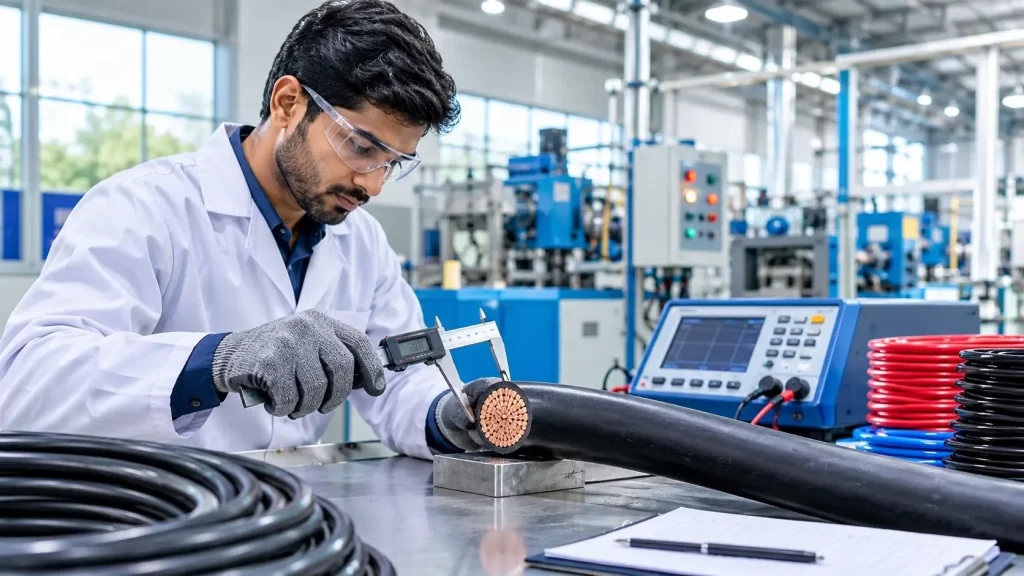
3.4 Dimensional testing
Used to identify if the cable has the correct dimensions.
Conductor dimensions can be tested, also insulation thickness, sheath thickness and cable diameter.
Why?
- Helps to confirm conductor dimensions and insulation dimensions.
- Helps to identify inconsistencies.
- Confirm that the cable matches approved drawings/specifications.
- Helps to maintain consistency between manufactured products.
It is important to have accurate dimensions, as conductor size and insulation structure will affect electrical/physical properties of the cable.
3.5 Measuring insulation thickness
Used to measure thickness of insulation material.
An appropriate measurement device/method to prepare the sample will be used to measure the insulation according to the test method.
Why?
- Helps to confirm correct insulation thickness according to the specification.
- Identify any unusual thinness/inconsistencies.
- Helps with product construction and quality.
- Helps ensure the cable is within dimensional requirements.
Minimum and average thickness requirements will vary depending on the cable design and standard.
3.6 Visual Inspection
A simple but important test.
The cable will be visually inspected by trained personnel looking for any obvious issues on the cable surface, print, insulation, sheathing and general appearance.
Typical checks are:
- Damage to the surface
- Irregularity on the insulation or sheathing
- Exposed conductor
- Inconsistent printing/identification
- Manufacturing irregularities
- Packaging and labelling condition
This inspection cannot be used as an alternative to electrical/mechanical testing but can help identify any visible issues with the product prior to dispatch.
3.7 Mechanical / Physical Testing
Depending on the cable type, certain physical testing is also carried out on the cable to establish the properties of the insulation and sheath.
This could be tensile strength, ageing, flexibility and other tests to determine the performance of different cable materials.
These tests help to determine if the correct physical properties are met.
Tensile strength and elongation can help determine how the insulation/sheath performs with regard to force and stretching under set test conditions.
The tests will depend on the cable construction and product standard.
4. Stages of Cable Testing
Routine Testing
Routine testing involves performing tests on manufactured lengths of cable at a given frequency as outlined in the standard/product specification.
The purpose of routine testing is to ensure that the manufactured lengths of cable meet the required routine testing criteria.
Examples may include conductor resistance and electrical endurance testing.
Sampling Testing
Sampling testing involves taking samples of finished cable or components and performing tests on them.
This helps to ensure that the manufactured products have the correct build and properties at given periods or frequencies.
Examples may include checking the conductor, dimensions and certain mechanical testing.
Type Testing
Type testing is performed to check whether a cable design will perform to the expected performance criteria for its application.
A general rule is that type testing is performed to prove that a cable design will work for the given specification. It may need to be repeated if modifications are made to the materials, build or manufacturing process that may impact upon performance.
It is important to understand that not all testing is performed on every length of cable. The frequency and acceptance criteria should be determined by the applicable standard.
5. Indian Standards for Electrical Cable Quality Testing
Electrical cables are produced, and tested in accordance with the appropriate Indian Standards and regulations.
The specific standard will depend on the cable type, voltage rating, materials and application.
| Indian Standard | Cable category |
| IS 694 | PVC-insulated wires and cables up to and including1,100 V |
| IS 1554 | PVC-insulated heavy-duty electrical cables |
| IS 7098 | XLPE-insulated electrical cables |
| IS 9968 | Elastomer-insulated cables |
| IS 14255 | Aerial bunched cables |
| IS 17048 | Halogen-free flame-retardant cables |
Each of these standards belong to a category of products and cannot be taken as the same. It is very important to ensure that the current version of the standard and any amendments, along with the certification and testing requirements of the specific product are known.
6. Equipment Used in Electrical Cable Testing
Cable manufacturers use various instruments and equipment.
Some common examples include;
- Digital micro-ohmmeters – for measuring low resistances such as conductor resistance.
- Insulation resistance testers – for measuring the resistance of electrical insulation.
- High voltage test equipment – for performing electrical withstand tests.
- Digital micrometers – measuring insulation and sheath.
- Vernier callipers – for measuring appropriate dimensions.
- Universal testing machines – for determining some mechanical properties such as tensile strength and elongation.
- Measuring microscopes – for looking at conductor dimensions and construction.
Using the correct apparatus and instruments (calibrated) is an important part of the QA process. Using documented test methods.
7. How Cable Manufacturers Ensure Quality
Cable quality is ensured through a reliable manufacturing process. The following quality assurance practices can be found in cable manufacturing:
Inspection of raw materials to ensure that they meet the specification and quality.
Monitoring of key process parameters during conductor manufacture, insulation extrusion, cabling, etc.
In-process inspection to ensure cables have not deviated in size or appearance.
Testing of cables to ensure they have passed all necessary tests.
Maintaining records of relevant processes, test results and product information.
Investigating failed tests, finding out the cause and putting in place the correct corrective action.
Using a quality management system ensures a consistent approach for cable manufacturers to improve their processes.
8. Quality Testing for Electrical Cables
Flashtronics Technologies provide a range of quality testing and assurance services for its wire and cable production.
The company states that they offer the following tests:
- High Voltage Testing
- Insulation Resistance Testing
- Conductors Resistance Testing
- Dimensional Testing
Flashtronics Technologies
They offer a range of cable solutions including wiring for building, flexible cables, power cabling, control/instrumentation, solar and bespoke cable requirements.
If you’re looking to assess your cable product, talk to the company about your application, technical specifications, test reports and relevant compliance requirements.
Visit Flashtronics Technologies to find out more about their wire and cable solutions and make an enquiry.
9) FAQs
What is wiring quality test?
Testing a cable to ensure that it meets the specific electrical, mechanical, physical and safety requirements.
Why do we conduct resistance test on conductor?
It helps to ensure that the conductor meets the specification on resistance. It helps to identify any discrepancies in conductor materials or dimensions.
What is insulation resistance test?
This test is performed to measure the resistance of the insulation material of a cable under test conditions. This will indicate the electrical characteristics of the insulation.
What is high voltage testing?
This test is performed to ensure that the insulation of the cable can withstand the test voltage at given time period.
What is dimensional test?
To ensure that the physical measurements of the cable such as conductor dimensions, insulation thickness, sheath thickness and diameter meet specifications.
Which Indian standards are relevant to wiring quality test?
The relevant standards include IS 694, IS 1554, IS 7098, IS 9968, IS 14255, IS 17048. This will depend on the category, type and voltage rating of the cable.
Conclusion
Quality testing electrical cables is a necessary step when producing reliable electrical wires and cables. From testing the cable’s resistance to the conductor, cable insulation, high voltage, cable dimensions, and mechanical testing there are many procedures which can be used to assess the quality of the cable.
Structured quality assurance processes help ensure the cable is made to a consistent standard and meets any technical specifications. Buyers can look at the quality assurance information provided in product data sheets, test reports and certifications.
At Flashtronics Technologies quality testing and inspection are a key part of our service when producing wires and cables. To find out more about our products please visit our website.